
Sage
Sage (SHMD-1901)
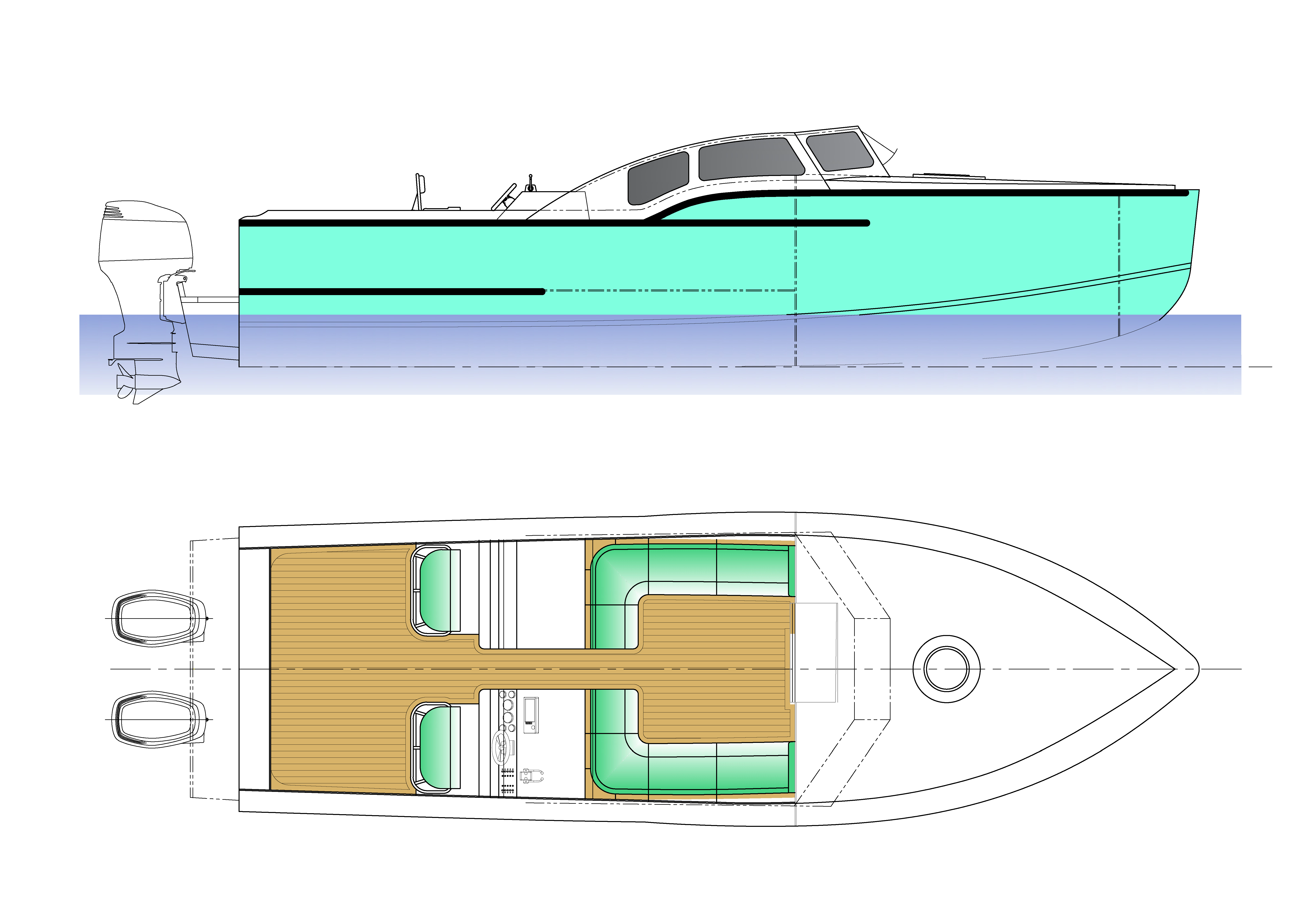
Key Features
• 35 ft. classic open day boat
• Modern construction with retro-styling
• Fast, sleek and comfortable for the whole family
• Economical and powerful - twin 250 hp four-stroke engine
| Max Speed (light load) | 35 kts |
| Max Speed (full load) | 30 kts |
| Engine | 2 x Suzuki 125 HP Outboard |
| Power | 250 hp @ 6000 rpm |
| Fuel | 170 gal |
| Length Overall | 35.7 ft |
| Length (hull) | 31.2 ft |
| Beam | 10.2 ft |
| Draft (motor down) | 2.6 ft |
| Bottom | 2 x 9.5mm (3/8") layers of laminated marine plywood, covered in 1208 fiberglass cloth, set in epoxy |
| Topsides | 2 x 6mm (1/2") layers of laminated marine plywood, covered in 1208 fiberglass cloth, set in epoxy |
| Deck | 1 x 8mm (5/16") layer of marine plywood |
| Bulkheads | 1 x 19mm (3/4") CNC cut marine plywood (okume) |
| Frames | 2 x 12.7mm x 95mm (1" x 3") CNC cut marine plywood (okume) |
| Keel | Laminated douglas fir |
| Adhesive | Epoxy |
Description
The open day boat is not an original idea and Sage is a homage to the big utilities that came before her, like the Mackenzie Cutty Hunk and the mass-produced Chris Craft Sea Skiff, Lyman Islander and Century Raven. Even today, FRP versions of this concept can be found and for good reason - it's not for what the boat is (for she is just a boat after all) but for what the boat represents. She is neither all of one thing and none of another. She is chicken noodle soup for the soul - an extension of the front porch of the family cottage - a place where memories are made. She is big enough to carry a family with all the in-laws for an excursion to an island or sandbar. She has accommodations when the little ones need a time out or time out of the sun. And an onboard head with privacy will keep the leadership happy.
It seems to be rare to find a boat this size without standing headroom below but, this was done intentionally because she is a day boat and wanted to keep her proportions and retro styling. The companionway hatch can be enlarged to allow standing at the sink and icebox. It is also to maximize the helm's field of vision. The helm was moved aft and passenger seating forward for several reasons. First, it keeps all the passengers in the skipper's field of vision - especially beneficial if a person cares about the comfort of their passengers and if children are on board. A bimini or hard top would expand the livable space from the accommodations and make her a legitimate weekender. The three-piece windscreen has hinged windows for improved ventilation. The arrangement could be further modified to achieve a greater level of comfort for longer trips. The aft deck is kept open and clear for fishing or diving or carrying other equipment.
She is powered with twin 200hp outboards which will push her about 27kts. Depending on the owner's, 'need for speed', larger engines could be used taking the vessel well into the 35-knot range. The twin installation also serves as redundancy. She has 18.5 degrees of deadrise with a constant warp or monohedron bottom. The outboard bracket is to boost her performance, reduce fuel consumption and improve handling. There is the knock-on benefit of serving as a swim platform. To keep a dryer a boat, spray rails are installed at the chine. The construction is cold molded with diagonally laid, 6mm marine plywood set in epoxy. The hull should be sheathed in a final layer of 1208 biaxial fiberglass cloth.
All of the frames and longitudinal girders are designed to be CNC cut from 19mm (3/4“) & 12mm (1/2”) marine plywood; preferably okume. Other major longitudinal members like the stem, keel, chines, and sheer clamp are to be of laminated Doug Fir. All members are to be epoxied together. Additional optimization and weight reduction could be accomplished if the builder were willing to use okume skinned, honeycomb panels for the cabin sole and seating.